
What does your moisturizer actually do?
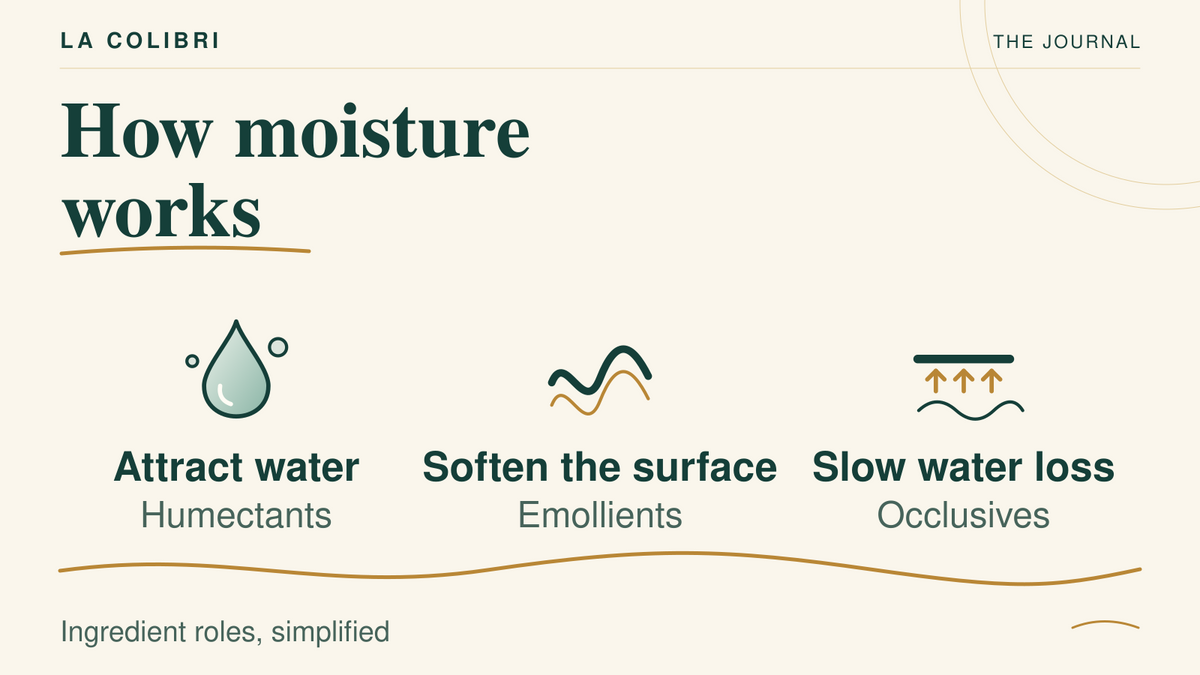
How moisture works
- Humectants attract water.
- Emollients soften and smooth the surface.
- Occlusive ingredients help slow water loss.
Ever wondered why a little cream can make freshly washed skin feel softer? A moisturizer brings together ingredients that help with water and surface softness, which is a useful place to begin when you are choosing one.
Let’s look at what happens at the skin’s surface, then connect it to a simple step you can use every day.
Your skin has an outer moisture barrier
The outermost skin layer is called the stratum corneum. It contains flattened cells surrounded by lipids, or fats. A helpful simplified picture is a wall: the cells are the bricks, and the lipids help form the material around them. Together, this outer layer helps limit water loss.
Your surface skin also renews itself. New cells move upward, while older cells shed. That everyday process is one reason it is worth caring gently for the surface you have, rather than treating every visible flake as a cue to scrub harder.
You can read more about skin structure in the WHO’s skin-physiology reference and the NIH’s healthy-skin guide.
Water, softness, and keeping moisture in
Moisturizing ingredients can contribute in different ways:
- Humectants attract water. Glycerin is one familiar example.
- Emollients soften and smooth the surface. Oils and other skin-conditioning ingredients can contribute to that comfortable feel.
- Occlusive ingredients help slow water loss. Different formulas provide different amounts of this effect.
A finished moisturizer can combine several of these roles. The balance helps shape its texture and performance, so it is worth choosing the whole formula rather than expecting one ingredient to do everything.
The American Academy of Dermatology’s moisturizer guide explains how creams, lotions, gels, and ointments differ. The right choice depends on your skin and how much moisture it needs.
How Replenish fits the picture
Replenish Facial Moisturizer is our cream for your face and neck, made to help skin feel soft and supple. Each jar contains 1.7 fl oz / 50 mL.
The formula includes aloe leaf juice, glycerin, coconut oil, sunflower oil, and jojoba oil. Glycerin helps attract water, while the oils contribute skin-conditioning benefits. Those roles give you a practical way to understand why the ingredients appear together.
Replenish also contains bergamot oil and organic alcohol. If you prefer fragrance-free skincare or avoid those ingredients, take a closer look at the full formula before choosing it. A moisturizer should fit your preferences as well as the step you want to fill.
Make the application easy
After cleansing, massage a pearl-sized amount upward over your face and neck, morning and night. If you use a serum, apply that first and let it absorb before your moisturizer. Keep Replenish away from your eyes and mouth, and stop using it if irritation occurs.
You can keep the cleanser you enjoy and add only the moisturizing step you need. If Replenish is new to you, a small-area product test can help you notice a reaction before broader use.
Choose comfort over more layers
Moisturizer is worth understanding because it has a straightforward place in a routine. You do not need to add several serums just because your skin feels dry. Begin by considering your cleansing and moisturizing steps and whether the formulas suit you.
Persistent dryness, painful cracking, or significant irritation deserves advice from a dermatologist. During the day, keep a separate broad-spectrum SPF 30 or higher sunscreen in your routine; Replenish is not a sunscreen.
Explore Replenish’s complete formula, or visit our practical Replenish application guide. Once you understand the job, choosing the next step feels a lot simpler.
Sources and product details
- WHO: Physiology of Normal Skin
- NIH: Healthy Skin
- American Academy of Dermatology: Choosing Moisturizer
- Cosmetic Ingredient Review: Glycerin
- European Commission: Cosmetic Ingredient Functions
- La Colibri: Replenish Facial Moisturizer
- American Academy of Dermatology: Testing Skin Care Products
- La Colibri: Replenish Product Record
- American Academy of Dermatology: Testing Skin Care Products
- Cleveland Clinic: Skin Barrier
Ingredient references explain ingredient roles. Studies of other formulas do not establish results for a La Colibri product. Product details come from La Colibri’s product information.
Leave a comment